
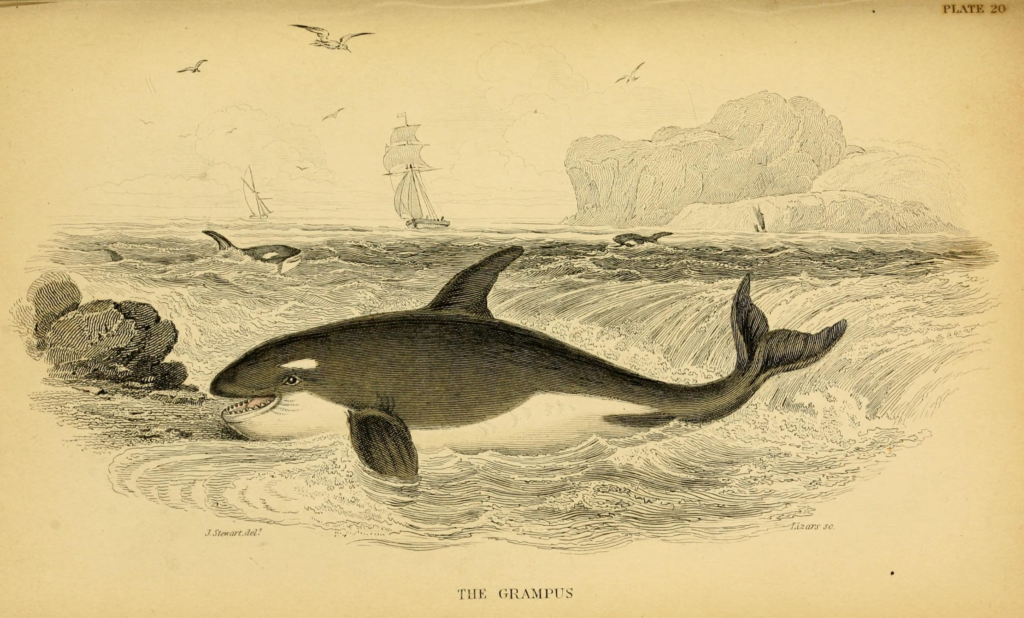
Before it occurred to us that the whales there were quite abused, my mum and I used to go to Marineland every summer. With my younger sister in tow, we’d make the walk from King Waldorf’s Walrus Palace to Friendship Cove to the picnic lunch area where a polka band played under the hot sun. We all loved the belugas the best, with their ridiculously bulging foreheads and goofy smiles. I distinctly remember the musky smell of salt and how I imagined it might feel to touch their shining skin. They leapt to catch fish and swam right up to the barrier, as if trying to say hello. Such great performers, such dazzling stars. Not so much the sole orca at Marineland. She swam in a circle, completely alone in her silent patrol. My sister and I pressed our grubby noses against the viewing glass, mesmerized by misery. My mum hummed the ‘baby beluga’ song under her breath.
Whales are famous for their families and their songs. When they’re alive, they are remarkably similar to us. Grandmothers diligently lead younger generations—surprisingly without the help of Google Maps. They eat a lot and occasionally sink yachts. When members of their pod die, they grieve. Whale deaths are a sad occasion that marine biologists love to study and write long papers about.
From this fascination, we know that smaller whales will decompose at the surface, picked apart by sharks, seabirds and other scavengers. But larger species, such as baleen or sperm whales, get a grander burial. The ocean depths they dominated in life become their grave. They sink from the sunlight-soaked and life-filled epipelagic zone, down past the dwindling light of the mesopelagic, all the way to the bathyal zone, the eerie midnight of the deep sea. This descent is called a whale fall. It’s the whale’s final send-off, their funeral of sorts.
—
My family passed funeral plans around the table in the manner that other families might pass the saltshaker. It was summertime sometime during the COVID years, a little after my grandad’s third heart attack. We were bored, in scheming moods, and sweating into the patio furniture while we ate burgers.
My sister requested, with her usual flourish: “No goddamn urn on the fireplace mantle. Just give me away to science and don’t talk to me again.” My dad asked to be put out with the compost, to which my mum pointed out the potential legal implications. He thought for a minute and then settled on being buried in Slovenia. My mum wanted whimsy for her final send-off. She wanted to be cremated and then smuggled around the world whenever we went on vacation. “Take me to the Alps! Sprinkle a bit of me in Chile or the Seychelles,” she said. My attempts to point out legalities were laughed off with the offer of more lemonade.
When the conversation came around to me, I said that I’d like one of those hippie burials where they don’t embalm you and plant a tree over your grave. No one was surprised. Earlier that year, I had become a pescetarian and started volunteering with an environmental organization. I had a not-so-secret wish to one day chain myself to an old-growth tree at a logging protest (but unfortunately lacked the resolve to follow-through).
So-called traditional burial is when the deceased is pumped with formaldehyde, dressed in a suit, and buried in a varnished casket. It became vogue during the American Civil War when dead soldiers needed to be transported long distances. It hasn’t fallen out of style. Each funeral uses about 12 litres of embalming fluid, which doesn’t stay in the body post-burial. The resource input numbers at the American national level are staggering: 20 million feet of wood, 1.6 million tons of reinforced concrete, 64,500 tons of steel. Everyone’s body decomposes eventually, but embalmed bodies in caskets take longer and poison the soil around them in the process.
—
Whales don’t need to worry about funeral plans. The ocean takes care of that for them. When a whale reaches the sessile plains of the ocean floor, scavengers arrive within hours. Deep water sharks tuck in for a good meal. Jawless hagfish stab themselves into the side of the carcass with abandon, while worms, crustaceans and eels comb over the bones again and again. Octopuses coat the surface in droves and burrow into the nutrient-rich soil.
Eventually, only bones remain. And even these are useful. For the next 50 years or more, chemosynthetic bacteria get to work breaking down fats in the bones. Polychaete worms form a fuzzy red carpet over the surface, while mussels and clams eat the microbes that eat the bones. A community quietly exists in the depths. Burial becomes a continuation of life.
—
Marineland got in trouble for the habit of illegally burying their animals onsite. Somewhere in the park, there is a mass grave of more than 1,000 corpses. You may have caught a glimpse of it if you ever rode the high-flying Sky Screamer rollercoaster.
I sometimes wonder who was burying those sea animals. The rational part of my brain reasons that it was probably the task of some poor interns, a boring chore. But the storyteller part of me, raised by film-buff English teachers, insists on whimsy. I imagine the Marineland Burial Squad as a team of secret agents cloaked in sunglasses, carrying out a mission circa 2011. Their somersaults dodged searchlights while hauling a dead walrus down a ravine. In essence, I imagine a bad Monty Python sketch— tragicomic send-offs for tragicomic lives.
The lone orca from Marineland died in 2023. She was necropsied, and I assume that she was buried properly, whatever that means for a captive orca.
—
Another summer, some years after we discussed funeral plans, I was pouring myself a glass of water in my parents’ kitchen when my mum sent me a text. I clicked on the link to find a playlist she’d created.
“Mum, you can’t be serious,” I said, walking into the living room. She laughed at me, her eldest fool.
“Dead serious.”
My mum’s aptly titled Funeral Playlist opens up with Janelle Monae’s boldly beautiful sci-funk ‘Electric Lady.’ It meanders through her favourite 90s club tracks, The Cowboy Junkies, Bjork, Florence, ABBA, The Muppet Show and The Tragically Hip before finally settling into The Sundays’ ‘Here’s Where The Story Ends’ and 10,000 Maniacs’ ‘More Than This.’ When she was in college, my mum went out dancing every weekend at clubs with loud music and bright lights.
Now, she goes out to brunch and sings to our elderly cat. Her closet is full of colourful sweaters. She texts me reminders about my upcoming MRI. That is to say that she is alive and well, and has no plans for a funeral anytime soon. But she wants assurance that, one day, her funeral will be loud, unapologetic, punchy, and above all, ridiculously joyfully sad. One day, I will be crying to Kermit the Frog. One day, I’ll scatter her ashes off the coast of the Maldives or Croatia. If the microbes or fish have manners, they’ll say thank you.
—
Whale deaths are sad, of course. Death is miserable and lonely for anyone—whale or human. Even the microbes who feast on our decomposing bodies don’t want to die.
Whales accumulate carbon throughout their lives of eating and singing, pulling it out from the life-abundant surface. When they die, that same carbon sinks with them. It’s been suggested that whale bones might provide the platform for coral reefs.
Every living thing relies on carbon. If you’re a plant, you pull it from the air. If you’re an animal or fungus, you steal it from another living thing. Death leads to decomposition, which releases more nutrients for the next generation of living things to sustain themselves with. Carbon circulates through the system in a balanced loop, until oil fracking or a volcanic eruption throws the whole thing out of whack. Embalming slows the process, but you can’t fight the inevitable.
A part of me refuses to believe that I am a part of this. That I won’t be decomposed and eaten by bacteria, underneath the surface of the formaldehyde-free hippie graveyard. I suppose that’s why I think death is absurd. What do you mean, this life is only temporary? That one day I will no longer sneeze, no longer sing off-key, never kiss again? Never stand in line, never stub my toe? Never jump in the water and feel it rush up my nose into my dizzy brain? No more ABBA and Cowboy Junkies?
At age twelve, I received a diagnosis and asked the doctor, “Am I going to die?” as if the answer wasn’t “yes.” Yes, you will die. I will die too. Maybe not this year, maybe not from this cancer, but we’re all just swimming towards the day we’ll tumble down into the depths of time. You’ll be feasted on by lucky detritivores who will love you like no one ever has before. You’ll be gently folded into the earth or absorbed by the ocean floor. You are one speck of water in an infinite ocean of life and death. An honoured member of the carbon cycle. Recipient of all that has come before you, and a contributor to all that will come after.
Isn’t that beautiful?
Illyria Volcansek is a student at the University of Guelph, studying ecology and creative writing as part of the Arts and Sciences program. She’s a queer dear who enjoys writing speculative fiction about the interactions between the human and more-than-human world.